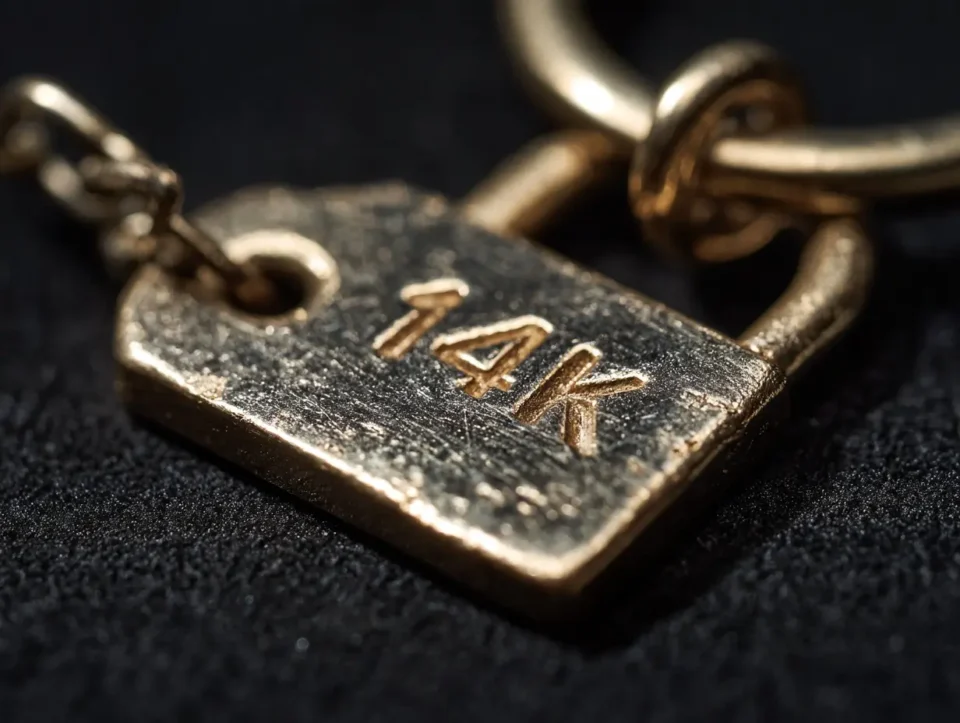
14K means the metal is 14 parts gold out of 24, or 58.3 percent pure gold, alloyed with metals such as silver, copper and zinc for strength and color. It is usually stamped “14K”, “14KT” or “585”. The stamp describes the purity of the alloy, not how much gold the piece contains.
Turn over almost any piece of gold jewelry and you will find a small stamp on the clasp, the inside of the band or the earring post. That stamp answers one question precisely: what fraction of the metal is gold. It does not tell you whether the piece is solid, hollow or plated with something underneath, and some stamps that look like gold marks mean the opposite. Here is how to read them.
What karat means
A karat is one twenty-fourth. Pure gold is 24 karat; 14 karat gold is 14 parts gold in 24, which works out to 58.3 percent. The rest of the alloy is other metals, chosen to harden the gold, which on its own is too soft for most jewelry, and to set its color: more copper for rose gold, more silver for a greener yellow, palladium or nickel for white gold.
Karat stamps and their numbers
| Karat | Gold content | Number stamp | Also seen as |
|---|---|---|---|
| 10K | 41.7% | 417 | 10KT |
| 14K | 58.3% | 585 | 14KT |
| 18K | 75% | 750 | 18KT |
| 22K | 91.7% | 916 | 22KT |
| 24K | 99.9% | 999 | 24KT, fine gold |
The number stamps are parts per thousand. You will notice 14K is marked 585 rather than 583: 583.3 is the exact fraction, but 585 is the conventional mark, and alloys made to it sit a little above the minimum.
Karat fractions and fineness marks follow Wikipedia’s entry on fineness.
Is 14K gold real gold?
Yes. 14K is genuine gold alloy, and a common choice for fine jewelry in the United States because it balances color, hardness and price. It is harder than 18K and much harder than pure gold, which is why it suits pieces worn every day. Our comparison of how hard 14K gold is covers the numbers.
How accurate does a 14K stamp have to be?
In the United States, a karat stamp is a legal statement. Under the National Gold and Silver Stamping Act, the gold in an article marked with a fineness may fall short of the mark by no more than three parts per thousand when tested without solder, and seven parts per thousand when the whole article, solder included, is tested. A piece stamped 14K that assays well below that is mismarked.
The tolerances are set out in 15 U.S.C. § 295 and noted in the FTC Jewelry Guides.
Stamps that mean plated, not solid
Some marks include a karat number but describe a thin layer of gold over another metal. Under the FTC Jewelry Guides, these terms have specific minimums:
| Stamp or term | What it means |
|---|---|
| GP, GEP, “gold plated”, “gold electroplate” | A gold layer at least 10K, electroplated at least 0.175 microns thick |
| HGE, “heavy gold electroplate” | The same, at least 2.5 microns thick |
| GF, “gold filled”, e.g. 1/20 14K GF | A layer of karat gold bonded to a base metal, at least 1/20 of the total weight |
| RGP, “rolled gold plate” | A bonded layer of at least 1/40 of the total weight |
| Vermeil | Sterling silver coated with at least 10K gold, at least 2.5 microns thick |
So “14K GP” or “14K HGE” is a base metal with a plating of 14K gold, not 14K gold. Our page on solid gold vs plated explains the difference in wear.
Definitions are from the FTC Jewelry Guides at 16 CFR § 23.3 and, for vermeil, 16 CFR § 23.4.
What a stamp doesn’t tell you
Construction. A hollow 14K chain is honestly stamped 14K and contains far less gold than a solid one of the same size. The stamp tells you purity, not quantity. Our guide to hollow vs solid gold explains how to tell.
Who made it. In the US, a quality mark is expected to appear with the maker’s registered trademark, so a karat stamp with no maker’s mark beside it is worth a second look.
Whether it’s genuine. Stamps can be faked. If you need certainty, our guide to how to tell if gold is real walks through the tests.
14K vs 10K vs 18K
14K sits in the middle: more gold and a richer color than 10K, harder and less expensive than 18K. Which suits you depends on how you will wear it: 14K for everyday pieces, 10K for hard-wearing ones on a budget, 18K for richer color worn with a little more care.
Shop 14K gold jewelryShop 14K gold chains
14K gold FAQ
What does 14K mean on a ring?
The ring’s metal is 14 parts gold out of 24, or about 58.3 percent gold.
What does 585 mean on gold?
It is the fineness mark for 14K gold: 585 parts gold per thousand.
Is 14K gold real gold?
Yes. It is a genuine gold alloy, widely used for everyday fine jewelry in the US.
What does 14K GP mean?
Gold plated: a base metal with a thin layer of 14K gold on the surface, not solid 14K gold.
Does 14K gold tarnish?
Very little. It can darken slightly over years in harsh conditions, which polishing removes.
Is 14K gold worth anything?
Yes. Its gold content is about 58 percent of its weight, and that gold has value whatever the piece.